الكتب المتبناة
Sixth Edition
1421 AH - 2001 CE
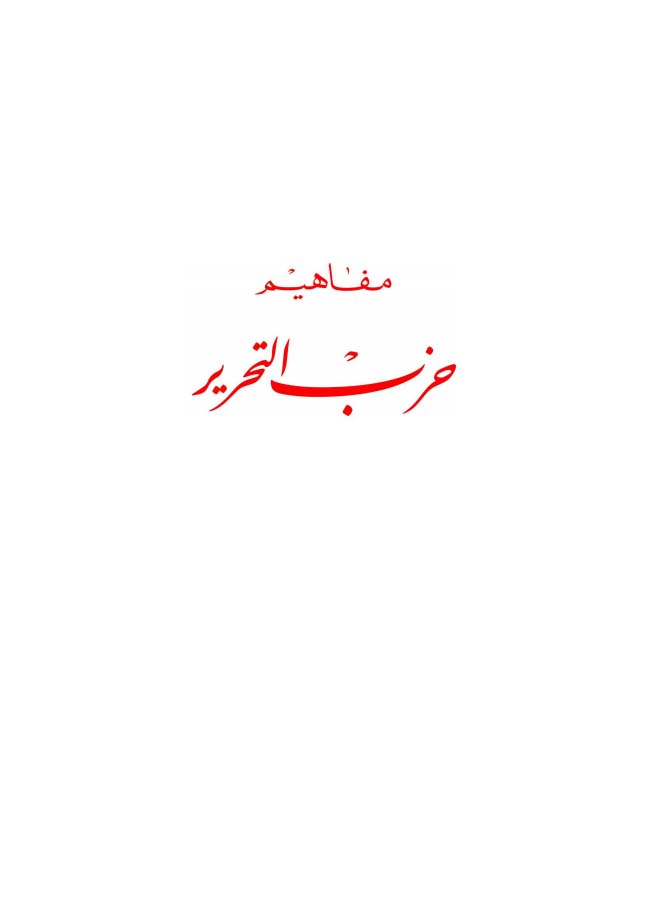
Concepts of Hizb ut Tahrir (Mafahim Hizb ut Tahrir)
Taqiuddin an-Nabhani
Since the mid-12th century AH (18th century CE), the Islamic world has been rapidly declining from its proper level, descending into an abyss of degradation. Despite numerous attempts to revive it or prevent its continued decline, none of these attempts have succeeded, and the Islamic world remains mired in the darkness of chaos and decline, still suffering the pain of this backwardness and turmoil.
The reason for its decline lies in one thing: the severe weakness that has afflicted minds in their understanding of Islam. The cause of this weakness is the separation of Arab energy from Islamic energy when the Arabic language was neglected in understanding and performing Islam since the early 7th century AH. Unless Arab energy is mixed with Islamic energy by making the Arabic language—which is the language of Islam—an essential and inseparable part of it, the decline will continue to drag down Muslims. This is because it is the linguistic energy that carried the energy of Islam and merged with it, so that Islam cannot be fully performed except through it. Because with its neglect, ijtihad (independent reasoning) in Islamic law will remain lost, and ijtihad in Islamic law is only possible with the Arabic language, because it is a fundamental condition in it. Ijtihad is necessary for the nation, because there is no progress for the nation except with the existence of ijtihad.
مقدمة / Introduction
Introduction Since the mid-12th century AH (18th century CE), the Islamic world has been rapidly declining from its proper level, descending into an abyss of degradation. Despite numerous attempts to revive it or prevent its continued decline, none of these attempts have succeeded, and the Islamic world remains mired in the darkness of chaos and decline, still suffering the pain of this backwardness and turmoil. The reason for its decline lies in one thing: the severe weakness that has afflicted minds in their understanding of Islam. The cause of this weakness is the separation of Arab energy from Islamic energy when the Arabic language was neglected in understanding and performing Islam since the early 7th century AH. Unless Arab energy is mixed with Islamic energy by making the Arabic language—which is the language of Islam—an essential and inseparable part of it, the decline will continue to drag down Muslims. This is because it is the linguistic energy that carried the energy of Islam and merged with it, so that Islam cannot be fully performed except through it. Because with its neglect, ijtihad (independent reasoning) in Islamic law will remain lost, and ijtihad in Islamic law is only possible with the Arabic language, because it is a fundamental condition in it. Ijtihad is necessary for the nation, because there is no progress for the nation except with the existence of ijtihad.خاتمة / Conclusion
Conclusion Hizb ut-Tahrir is a political party whose foundation is Islam and whose goal is to resume the Islamic way of life by establishing an Islamic state that implements the systems of Islam and carries its call to the world. This party has prepared a party culture that includes Islamic rulings on matters of life. The party calls for Islam as an intellectual leadership from which systems emanate that address all of humanity's problems, political, economic, cultural, social, and otherwise. It is a political party that includes women in its membership as well as men, and it calls all people to Islam and to adopt its concepts and systems, viewing them, regardless of their different nationalities and sects, with the view of Islam. It relies on interaction with the nation to achieve its goal, and it combats colonialism in all its forms and names to achieve the liberation of the nation from its intellectual leadership and to eradicate its cultural, political, military, economic, and other roots from the soil of the Islamic countries, and to change the false concepts that colonialism has spread, limiting Islam to worship and morals.
شارك الكتاب: