
الكتب المتبناة
Sixth Edition
1422 AH - 2002 CE
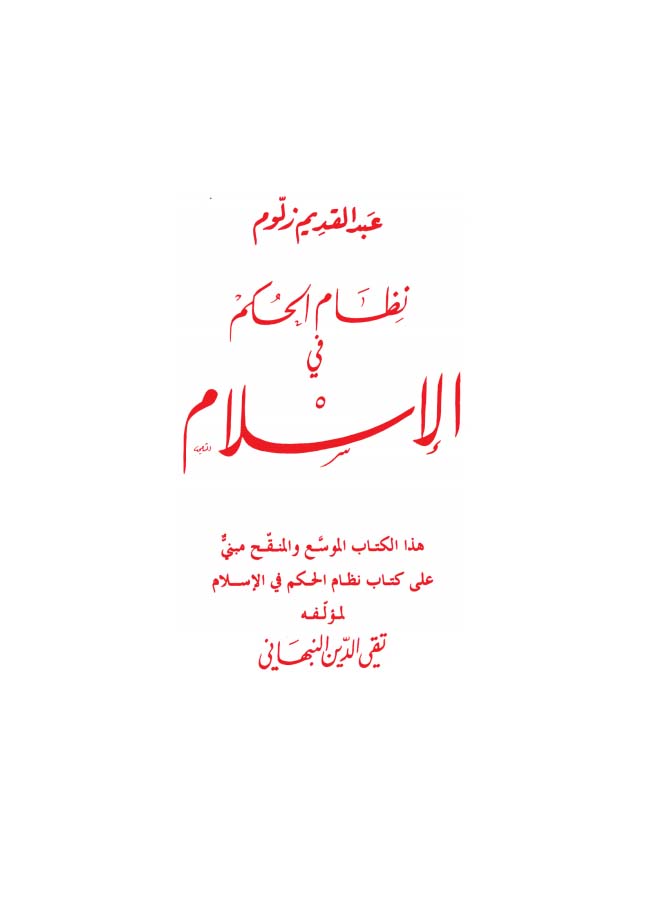
The Ruling System in Islam
Taqiuddin an-Nabhani
The first edition of the book 'The System of Governance' was written in the early 1950s, a time when Western culture had a significant influence on the minds of Muslim intellectuals. One of the effects of this influence was the prevailing notion that Islam was a theocratic religion with no system capable of addressing the problems of life in the modern era, nor a system of governance for a state, viewing its state as a 'religious-spiritual' entity.
Those working for Islam were advocating general, unformed ideas lacking the clarity to present Islam as a complete system for life, state, and society. They were calling for a general return to Islam without a clear vision of Islamic systems or how to re-establish governance according to Islam. Their calls overlooked the fact that re-establishing governance according to what God revealed could only be achieved through the establishment of the Caliphate. Therefore, the establishment of the Caliphate and the re-establishment of governance according to what God revealed had no place in their action plan.
At that time, a group studied the reality of the Ummah, its present state and what it had become, and studied its history and the power and authority it possessed in a state that was the leading state in the world. This state was based on Islamic creed and the resulting Sharia rulings, putting them into practice and bearing them as a message to the world. The group then studied Islam from its original sources in the Quran and Sunnah, with a conscious study, and concluded that it is a complete and comprehensive system that addresses all life's problems. They produced books illustrating all of this in general, without going into many details, creating a book on the Islamic system, a book on the system of governance, a book on the economic system, and a book on the social system. In writing these books, they considered the practical aspect so that Muslims would realize that Islam is a practical principle and a complete system suitable for application, so that they would adopt its systems and work to establish them in real life, by working to establish the Caliphate, which is the only way to apply these systems and bring them into reality.
مقدمة / Introduction
The first edition of the book 'The System of Governance' was written in the early 1950s, a time when Western culture had a significant influence on the minds of Muslim intellectuals. One of the effects of this influence was the prevailing notion that Islam was a theocratic religion with no system capable of addressing the problems of life in the modern era, nor a system of governance for a state, viewing its state as a 'religious-spiritual' entity. Those working for Islam were advocating general, unformed ideas lacking the clarity to present Islam as a complete system for life, state, and society. They were calling for a general return to Islam without a clear vision of Islamic systems or how to re-establish governance according to Islam. Their calls overlooked the fact that re-establishing governance according to what God revealed could only be achieved through the establishment of the Caliphate. Therefore, the establishment of the Caliphate and the re-establishment of governance according to what God revealed had no place in their action plan. At that time, a group studied the reality of the Ummah, its present state and what it had become, and studied its history and the power and authority it possessed in a state that was the leading state in the world. This state was based on Islamic creed and the resulting Sharia rulings, putting them into practice and bearing them as a message to the world. The group then studied Islam from its original sources in the Quran and Sunnah, with a conscious study, and concluded that it is a complete and comprehensive system that addresses all life's problems. They produced books illustrating all of this in general, without going into many details, creating a book on the Islamic system, a book on the system of governance, a book on the economic system, and a book on the social system. In writing these books, they considered the practical aspect so that Muslims would realize that Islam is a practical principle and a complete system suitable for application, so that they would adopt its systems and work to establish them in real life, by working to establish the Caliphate, which is the only way to apply these systems and bring them into reality.Table of Contents
1.
Opening Verse
2.
Introduction
3.
Preamble
4.
Governance in Islam
5.
The Islamic State
6.
The Form of Government in Islam
7.
The Form of Government in Islam Is Not Monarchical
8.
The Form of Government in Islam Is Not Republican
9.
The Form of Government in Islam Is Not Imperial
10.
The Form of Government in Islam Is Not Federal
11.
The System of Governance in Islam: The Caliphate
12.
Rules of Governance
13.
Sovereignty Belongs to the Sharia
14.
Authority Belongs to the Ummah
15.
Appointing One Caliph is Obligatory
16.
The Right of Adoption Belongs to the Caliph Alone
17.
The Organs of the State
18.
The Caliph
19.
Conditions of the Caliph
20.
Conditions of Convening
21.
Conditions of Preference
22.
Establishment of the Caliphate
23.
The Rule of the Usurper
24.
Those by Whom the Caliphate is Established
25.
Who Are Those Who Appoint the Caliph?
26.
The Pledge of Allegiance (Bay'ah)
27.
Seeking the Caliphate
28.
The Method of Appointing the Caliph
29.
Succession or Covenant
30.
The Office of Heir Apparent
31.
The Term of Presidency for the Caliph
32.
The Period in Which Muslims Are Granted to Establish a Caliph
33.
The Unity of the Caliphate
34.
The Powers of the Caliph
35.
How the Caliph Cares for the Affairs of the People
36.
The Caliph Is Bound in Adoption by Sharia Rulings
37.
Dismissal of the Caliph
38.
The Ummah Does Not Have the Right to Dismiss the Caliph
39.
The Court of Grievances Is the One That Has the Right to Dismiss the Caliph
40.
The Caliphate State Is a Human State, Not a Divine State
41.
Leadership in Islam Is Individual, Not Collective
42.
The Assistants
43.
The Delegated Assistant
44.
Conditions of the Delegated Assistant
45.
Conditions for Conferring the Delegated Assistant Post
46.
The Work of the Delegated Assistant
47.
The Executive Assistant
48.
The Commander of Jihad
49.
The Department of Foreign Affairs
50.
The Department of Military Affairs
51.
The Department of Internal Security
52.
The Department of Industry
53.
The Army
54.
Divisions of the Army
55.
Army Brigades and Their Banners
56.
The Caliph Is the Commander of the Army
57.
Educating the Army with Military and Islamic Culture
58.
The Islamic State Is in a Constant State of Jihad
59.
The Governors
60.
Appointing and Dismissing Governors
61.
The Powers of the Governor
62.
The Caliph Must Investigate the Actions of the Governors
63.
The Judiciary
64.
Types of Judges
65.
Conditions of Judges
66.
Conferring the Judge Post
67.
Formation of Courts
68.
The Muhtasib (Overseer)
69.
The Powers of the Muhtasib
70.
The Judge of Grievances
71.
Appointing and Dismissing Judges of Grievances
72.
The Powers of the Judge of Grievances
73.
The Administrative Apparatus
74.
The Administrative Apparatus Is a Method of Administration, Not Governance
75.
Judging Interests Is Part of Taking Care of Affairs
76.
Administrative Details
77.
Policy of Managing Interests
78.
Who Has the Right to Be Employed in State Organs?
79.
Employees of the State Are Hired Workers
80.
The Ummah Council
81.
The Right of Consultation (Shura)
82.
The Ruling on Consultation
83.
Electing Members of the Ummah Council
84.
Term of Membership in the Ummah Council
85.
Membership in the Ummah Council
86.
Powers of the Ummah Council
87.
The Right to Speak and Express Opinion Without Embarrassment
88.
Islam Must Be Applied Completely at Once, and Gradualism in Applying Its Rulings Is Forbidden
89.
Islam Forbids Governance from Being Police-State Like
90.
Islam Forbids Harming Muslims and Spying on Them
91.
Obedience to the Muslim Ruler Who Governs by Islam Is Obligatory
92.
No Obedience in Disobedience
93.
Holding Rulers Accountable Is Obligatory on Muslims
94.
It Is Obligatory to Fight the Ruler If He Shows Blatant Disbelief
95.
Establishing Political Parties Is a Collective Obligation (Fard Kifaya)
96.
Guaranteeing the Application of Islam
خاتمة / Conclusion
It is difficult for the Ummah to discuss or hold the state accountable without having a party to assume the central leadership role of the Ummah towards the state, due to the numerous difficulties it faces, which can only be overcome by the existence of a unified leadership embodied in a bloc, not in an individual or individuals. Hence, it was necessary for a principled political party to arise within the Ummah, its sole task being to carry the Islamic call, and its only way to carry the call is through the political path. The establishment of this party was inevitable because it is the practical means that leads the Ummah and ensures, through its leadership, that the state fulfills its mission to the fullest extent by carrying the Islamic call, applying Islam, and ensuring the continuity of this application. It is also the practical means to prevent its misapplication. The Prophet Muhammad's (peace be upon him) consolidation of Muslims around Islam was evident in Dar al-Arqam, and then included all the Companions. They were the bloc that stood among the Muslims, practically bearing the responsibility of Islam, even though all Muslims generally bear the responsibilities of Islam. It is narrated that the Messenger of God (peace be upon him) died with sixty thousand Companions. These are the Islamic bloc or the Islamic party that practically bears the responsibility of Islam, otherwise, the Muslims at the time of the Prophet's death were many times more than that. When the era of the Companions, the Successors, and the Successors of the Successors ended, the party vanished, and weakness began to creep into the hearts of the rulers, due to the absence of the party that leads the Ummah to monitor, discuss, and hold them accountable. This continued until the misapplication of Islam occurred. Therefore, the real guarantee for the application of Islam, carrying its call, and ensuring its proper application is the Islamic political party.
شارك الكتاب: