الكتب المتبناة
Fourth Edition
1424 AH - 2003 CE
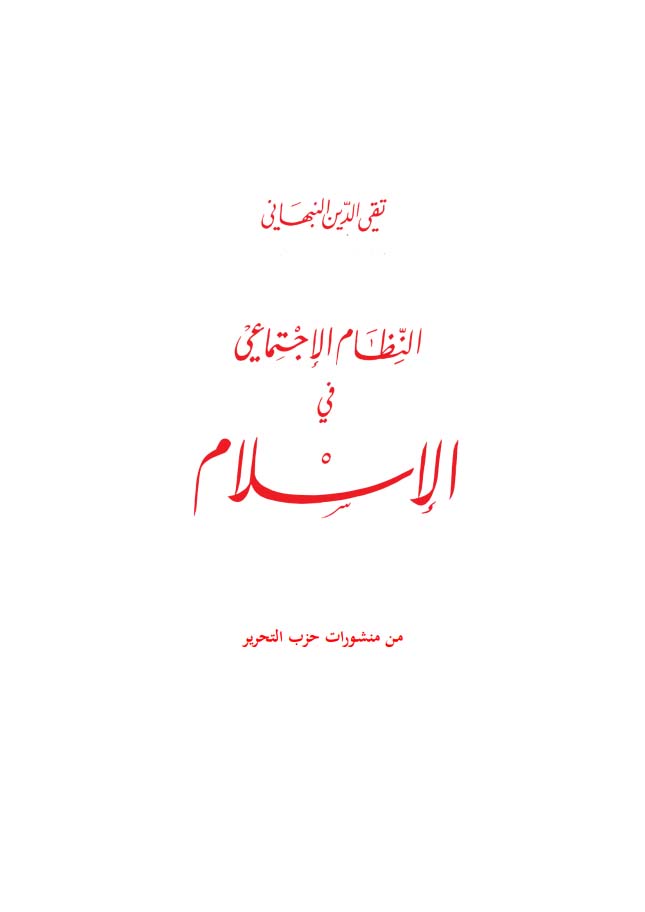
The Social System in Islam
Taqiuddin an-Nabhani
The social system is confined to the system that clarifies the organization of women's interaction with men and men's interaction with women, and regulates the relationship between women and men arising from their interaction, not from their interests in society, and clarifies everything that branches out from this relationship.
مقدمة / Introduction
Many people go too far in applying the term "social system" to all systems of life, which is incorrect. It would be more appropriate to call these systems "community systems," as they truly regulate the relationships between people living in a specific community, regardless of their interaction or separation. The interaction itself isn't the focus; rather, the relationships are. Hence, they are diverse and varied according to the multiplicity and difference of relationships, encompassing economics, governance, politics, education, penalties, transactions, evidence, and more. Therefore, applying the term "social system" to them is unwarranted and doesn't fit. Furthermore, the word "social" is an attribute of the system, so this system must address the organization of problems arising from interaction or relationships resulting from interaction. The interaction between men and men, or women and women, doesn't require a system because it doesn't give rise to problems or relationships needing regulation. However, regulating interests between them requires a system, considering they live in the same country even if they don't interact. As for the interaction between men and women, this is what creates problems requiring systematic organization, and relationships that require systematic regulation. Thus, this interaction is best described as the social system because it truly organizes the interaction between men and women and regulates the relationships that arise from this interaction.Table of Contents
1.
Opening Verses
2.
Introduction to the Social System
3.
Women and Men
4.
The Impact of the View on the Connections Between Men and Women
5.
Organizing Connections Between Women and Men
6.
Private Life
7.
The Obligation of Separating Men from Women in Islamic Life
8.
Looking at Women
9.
The Muslim Woman Is Not Required to Cover Her Face
10.
Women and Men Before Sharia Obligations
11.
Women's Work
12.
The Islamic Community
13.
Marriage
14.
Prohibited Women (for Marriage)
15.
Polygamy
16.
The Prophet's Marriage (peace be upon him)
17.
Married Life
18.
Coitus Interruptus
19.
Divorce
20.
Lineage
21.
Li'an (Mutual Cursing)
22.
Guardianship of the Father
23.
Child Sponsorship
24.
Kinship Ties
خاتمة / Conclusion
Islam divides relatives into two categories: those who can inherit from a person upon their death, and those who are considered close relatives (ulu al-arham). Those entitled to inheritance are the fixed-share heirs and the residuary heirs. Close relatives are those who are neither, lacking a fixed share in the inheritance and not being residuary heirs. They consist of ten categories: the maternal uncle and aunt, the maternal grandfather, the daughter's child, the sister's child, the brother's daughter, the paternal uncle's daughter, the paternal aunt, the paternal uncle from the mother's side, the brother's son from the mother's side, and anyone related through one of these. Allah has not granted them any share in a person's inheritance at all. However, Allah commands maintaining and being kind to all relatives. Jabir (may Allah be pleased with him) reported that the Prophet (peace be upon him) said: "If one of you is poor, let him begin with himself; if he has surplus, then let it be for his family; if he has surplus, then let it be for his relatives." Reported by Ibn Hibban and Ibn Khuzaimah. Abu Ayyub al-Ansari reported that a man said: "O Messenger of Allah, inform me of an act that will admit me into Paradise." The people said, "What is wrong with him? What is wrong with him?" The Messenger of Allah (peace be upon him) said: "He has something to ask." The Prophet said: "Worship Allah and do not associate anything with Him, establish prayer, pay Zakat, and maintain kinship ties." Reported by Bukhari. He commanded maintaining kinship ties, and this hadith and other hadiths regarding maintaining kinship ties do not specify whether the intention is only close relatives or everyone related to the person. The apparent meaning of the hadiths is general, encompassing maintaining ties with every relative, whether they are mahram (unmarriageable) relatives or non-mahram relatives from the residuary heirs or close relatives, for they are all considered relatives. Several hadiths have been narrated regarding maintaining kinship ties. The Prophet (peace be upon him) said: "The one who cuts off kinship ties will not enter Paradise." Reported by Muslim from the narration of Jubair bin Mut'im. Anas bin Malik reported that the Messenger of Allah (peace be upon him) said: "Whoever loves that his provision be expanded and his lifespan be extended should maintain his kinship ties." Agreed upon. Meaning his lifespan will be extended. Abu Huraira reported that the Prophet (peace be upon him) said: "Verily, Allah created the creation until, when He finished creating, the womb (kinship) stood up and said, 'This is the position of one who seeks refuge with You from being severed.' He said, 'Yes, will you not be pleased that I maintain ties with whoever maintains ties with you and sever ties with whoever severs ties with you?' It said, 'Yes, O Lord.' He said, 'Then that is for you.'" The Messenger of Allah (peace be upon him) said: "Recite if you wish: 'So would you perhaps, if you turned away, cause corruption on earth and sever your [ties of] relationship?'" Agreed upon, and the wording is from Bukhari. And he (peace be upon him) said: "The one who reciprocates is not the true maintainer of kinship ties, but the true maintainer is the one who, when his kinship is severed, he maintains it." Reported by Bukhari from the narration of Abdullah bin Amr. All of this indicates encouragement to maintain kinship ties. Maintaining kinship ties demonstrates the extent of the connection and affection that Allah has prescribed among the Islamic community, in the connection of relatives with one another and their cooperation, and the extent of the Sharia's concern in organizing women's interaction with men, organizing the relationships that arise from this interaction, and what branches out from it. Therefore, Islamic law, with the rulings prescribed for the social aspect of society, is the best social system for humans.
شارك الكتاب: