Download Book
Arabic ar
كتب غير متبناة
First Edition
Safar 1443 AH
September 2021 CE
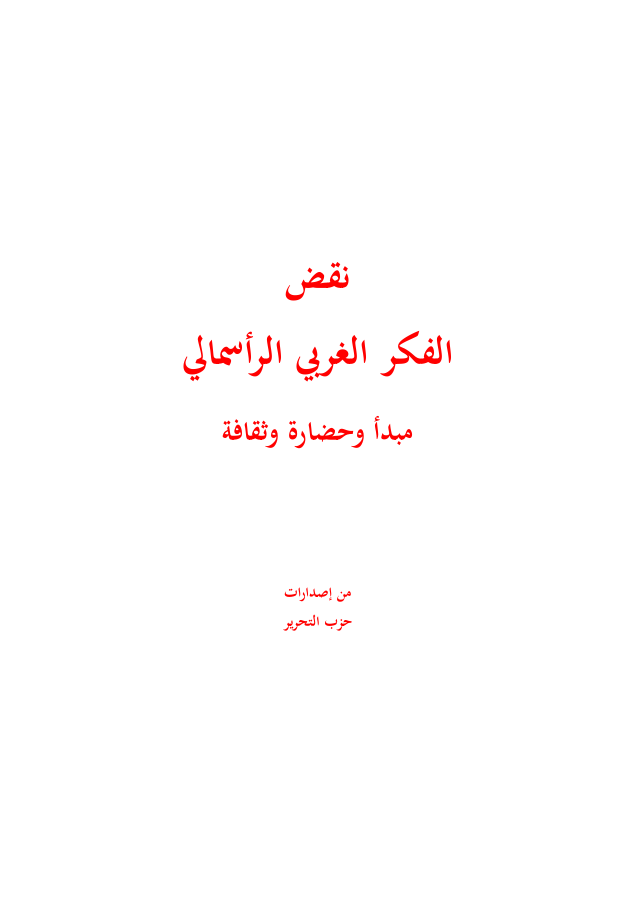
Refutation of Capitalist Western Thought
Hizb ut Tahrir
The book provides an introduction to Western capitalist thought, examining its origins, essence, and critique. It then delves into a critique of the Western way of thinking and the Western capitalist ideology, highlighting the flaws of secularism as a doctrine, as an intellectual foundation, and as intellectual leadership. Furthermore, the book addresses the Western method of spreading its capitalist principles and critiques it from an Islamic perspective. It also critiques the capitalist economic system in terms of economic substance, freedom of ownership (private property), and the concept of production, presenting the Islamic perspective on the economic system in Islam. It reviews the economic problems in the capitalist system and critiques the most important concepts of Western civilization, such as individualism and freedom.
مقدمة / Introduction
In the nineteenth century CE (thirteenth century AH), the structure of Western thought was completed, transforming from mere ideas and theories theorized by their proponents into a complete principle in its doctrine, system, and civilizational and cultural perceptions. It became known as the capitalist principle, which was adopted by Western European countries and carried to the world, including the Islamic world, through colonialism. European countries, led by Great Britain, which was the superpower at that time, were able to shake the foundations of the Islamic Caliphate (the Ottoman Empire), which had frozen cultural movement and stopped its Muslims from productive thinking, lost parts of its entity, and its global political influence diminished until it became known as the dying sick man whom the world was waiting to declare dead. This happened at the beginning of the twentieth century CE (fourteenth century AH), in 1924 CE, when the Islamic Caliphate officially fell. With its fall, Islam was no longer present on the global political scene as a principle carried by a state, although it remained present in the world carried by individuals and peoples.Table of Contents
1.
Contents
2.
Introduction
3.
Introduction to Western Capitalist Thought: Its Origins, Essence, and Critique
4.
The Genesis of Western Thought
5.
The Essence of Western Thought
6.
Critique of the Western Way of Thinking
7.
Reason and Rationality
8.
Science and the Scientific Method
9.
On the Concept of Truth
10.
Critique of the Western Capitalist Ideology
11.
The Corruption of Secularism as a Doctrine
12.
The Corruption of Secularism as an Intellectual Foundation
13.
The Corruption of Secularism as Intellectual Leadership
14.
Critique of the Western Method of Spreading its Capitalist Principles
15.
The Capitalists' Method of Spreading their Principles
16.
The Historical Background of Western Colonialism
17.
The Intellectual Background of Western Colonialism
18.
Critique of the Western Colonial Method
19.
Critique of the Western Capitalist System
20.
Critique of the Capitalist Economic System
21.
1- Economic Substance
22.
2- Freedom of Ownership (Private Property)
23.
3- The Concept of Production
24.
4- The Economic Problem
25.
Critique of the Democratic System of Governance
26.
Critique of the Western Social System
27.
1- The View of Men and Women
28.
2- Sexual Relations
29.
Critique of the Most Important Concepts of Western Civilization
30.
Critique of the Idea of Individualism
31.
Critique of the Idea of Freedom
32.
Conclusion and Salvation...
خاتمة / Conclusion
Man's actions in Islam are not arbitrary but intentional. He proceeds according to God's command and prohibition, adhering to the Sharia ruling in actions for the sake of a goal he seeks and a purpose he achieves. Thus, his actions are guided by rulings that produce an intended result, which the Muslim considers in his work, i.e., achieving a specific value for the individual and the community. By following the Sharia rulings, it can be seen that the values that the Sharia has designated and determined through addressing human problems in life are four: material, spiritual, ethical, and humanitarian. If a Muslim works to achieve these values according to the rulings of the Sharia, as it has defined, measured, and arranged them in a scale, all the values will be realized in the society to the extent required for it as a Muslim society, ensuring the achievement of prosperity and tranquility for all. God Almighty said: "Those who believe, and whose hearts find rest in the remembrance of God, verily, in the remembrance of God do hearts find rest." In conclusion, we call on all humanity, including the Western peoples, to reconsider their current state, to reject capitalist thought and Western civilization, and to adopt Islam instead, as it alone is capable of saving humanity from the misery it is experiencing and bringing it out of the darkness of injustice and darkness into the light of justice and truth.
شارك الكتاب: