Download Book
Arabic ar
كتب غير متبناة
Third Edition
1410 AH – 1990 CE
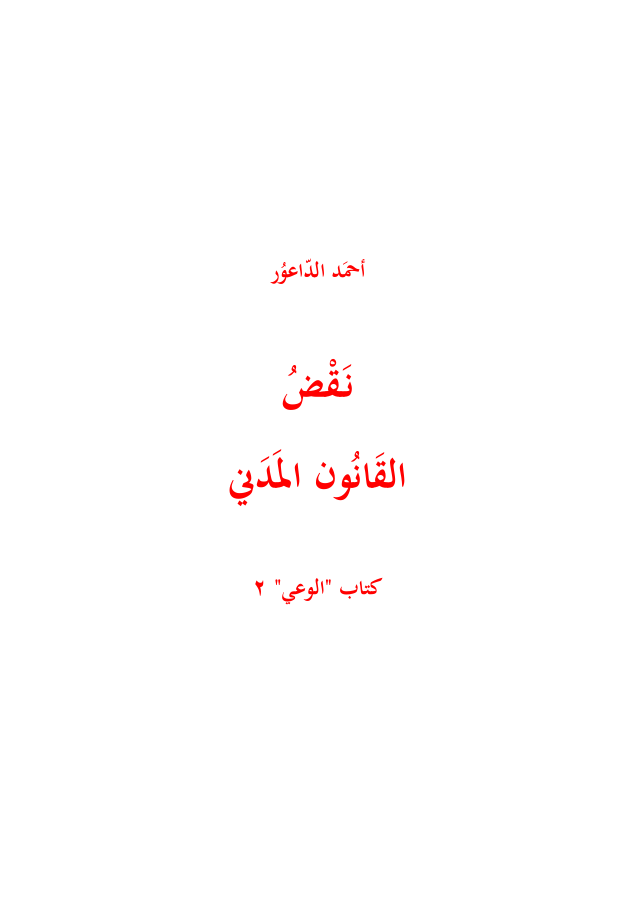
Al-Waie Book - Refutation of Civil Law 1955
Ahmad al-Da'our
"The Book of Awareness: A Critique of the Civil Code of 1955." This book seeks to expose the roots and contradictions of secular laws, advocating for a return to Islamic Sharia. The first book in this series was: "Intellectual and Media Pollution in the Islamic World" by Professor Ayed Al-Shaarawi.
مقدمة / Introduction
"Al-Wa'i" (Awareness) magazine strives to live up to its name, endeavoring to be worthy of it. To fulfill its mission, it has decided to publish a non-periodic series of valuable books that contribute to spreading awareness within the Islamic nation. This series is named: "The Book of Awareness." The first book in this series was: "Intellectual and Media Pollution in the Islamic World" by Professor Ayed Al-Shaarawi. The second book is the one in our hands: "A Critique of the Civil Code" by Sheikh Ahmed Al-Da'our. On the principle of "those who are worthy recognize the merit of its people," specialists in law, jurisprudence, and thought appreciate the value of this book, in its delving into the roots of secular laws, stripping them of their embellishments, and revealing their true nature of contradiction, which leads to human misery instead of happiness. This book is a pioneer in this field, and hope is pinned on the men of thought, jurisprudence, and law in the Islamic nation to follow this path, to refute all secular laws and return to the Sharia of Islam, which the Wise, the Expert, has revealed. ((There has come to you from Allah a light and a clear Book (15) By which Allah guides those who pursue His pleasure to the ways of peace and brings them out from darknesses into the light, by His permission, and guides them to a straight path (16)))Table of Contents
1.
Contents
2.
Introduction to "Awareness"
3.
Introduction to the First Edition
4.
Introduction to the Third Edition
5.
Critique of the Civil Code
6.
1) The Proposed Project
7.
2) Sources of the Project
8.
A- The Old Egyptian Civil Code
9.
B- Modern Codifications
10.
C- Islamic Sharia
11.
3- The Perspective on Which the Project is Based
12.
4) The Jurisprudential Origin of Civil Laws
13.
Obligation:
14.
The Theory of Obligation:
15.
Definition of the Source of Obligation:
16.
Order of Sources of Obligation
17.
5- Islamic Sharia
خاتمة / Conclusion
These are the Sharia-based reasons indicated by the text, and they are sufficient to make the text a broad outline, wide enough to regulate every action, and give judgment on every incident that occurs, no matter how new and numerous these incidents become. For this reason, it was inevitable that the Sharia texts should be the evidence for rulings, not personal rights, nor property rights, because they alone clarify the truth. The jurisprudential wealth left by thousands of Mujtahideen, and which was recorded by thousands of jurists, is considered the richest jurisprudential wealth in the world, and it has addressed problems that occurred and were applied by the Islamic judiciary for thirteen centuries, and it is sufficient for the state to adopt rulings from it to address the problems that have occurred, and the broad outlines are sufficient to derive the rulings that have been renewed. The state adopts from these deductions, and thus develops for the nation a law that is Sharia rulings derived by sound reasoning. Therefore, this proposed project is fundamentally flawed, and it is contrary to the Sharia rulings, so it must be rejected, and we must return to the Sharia rulings to enact them alone as laws for the people.
شارك الكتاب: