Download Book
Arabic ar
كتب غير متبناة
2018/04/03 CE
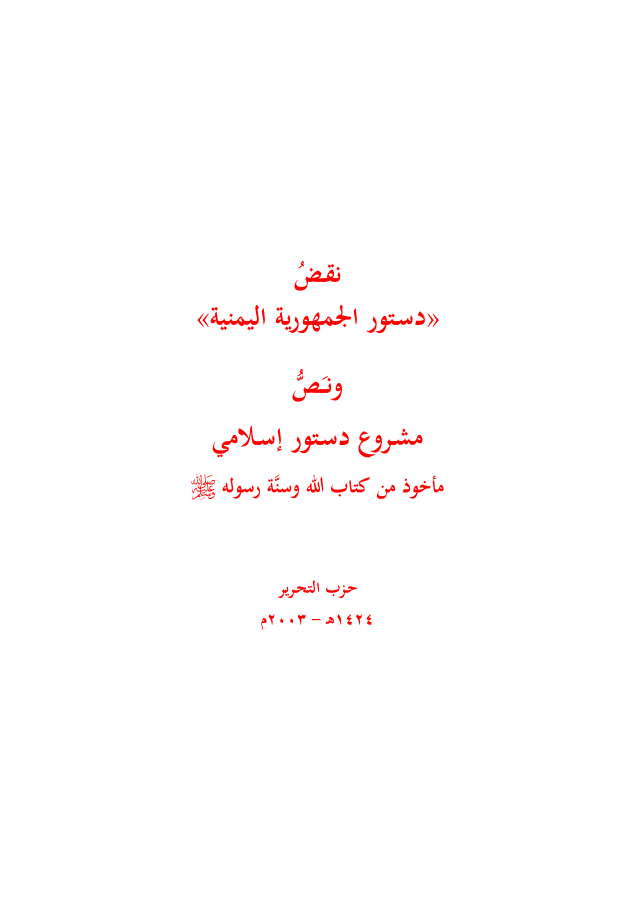
Refutation of the Yemeni Constitution (2003)
Hizb ut Tahrir
The book discusses the necessity of implementing Sharia law and criticizes the existing legal systems in Muslim countries, arguing for the establishment of an Islamic state (Caliphate) based on the Quran and Sunnah. It also criticizes secularism and democracy as foreign concepts imposed by colonial powers and their agents.
مقدمة / Introduction
Allah Almighty says: "But no, by your Lord, they will not [truly] believe until they make you, [O Muhammad], judge concerning that over which they dispute among themselves and then find within themselves no discomfort from what you have judged and submit in [full, willing] submission (65)." Implementing God's law and resorting to it is a known necessity in religion. Whoever denies it is an infidel who denies what was revealed to Muhammad, peace be upon him. Whoever acknowledges it but does not act upon it is a disobedient, wicked, and unjust person. This is clarified in God's book: "And whoever does not judge by what Allah has revealed - then it is those who are the disbelievers.", for those who deny and reject it. "And whoever does not judge by what Allah has revealed - then it is those who are the wrongdoers.", "And whoever does not judge by what Allah has revealed - then it is those who are the defiantly disobedient," for those who acknowledge God's judgment but do not judge by it. Muslims never accepted any ruling other than the rule of Islam, in belief and action, nor any state other than the state of Islam, the Caliphate, since the Messenger of God, peace be upon him, established the first Islamic state in Medina, followed by the Rightly Guided Caliphs, and the caliphs after them, until the disbelieving colonizer, in cooperation with agents and traitors, was able to eliminate the Caliphate state at the beginning of the last century. After that, the disbelieving colonizer occupied the lands of the Muslims, some with its armies and some with its influence. He took care to spread his culture and civilization among the Muslims. He deliberately created a class of agent rulers who do not rule according to what God revealed, and a class of (sheikhs) of the sultans who issue fatwas that do not please God. Thus, there was a policy of misinformation and ignorance, until the concepts of disbelief, such as separating religion from life, in the name of secularism, and enacting laws by humans without God in the name of democracy, and the like, found their way to the lands of the Muslims, sometimes by the actions of the rulers, their oppression and their subservience to the West, and sometimes by the actions of the (sheikhs) of the sultans with false fatwas that they use to confuse people about their religion, until the systems of disbelief and its rulings became public in the lands of the Muslims.خاتمة / Conclusion
Article 186 - Organizations that are not based on Islam, or the application of rulings other than the rulings of Islam, the state is not permitted to participate in them, such as international organizations such as the United Nations, the International Court of Justice, the International Monetary Fund, and the World Bank, and regional organizations such as the Arab League.
شارك الكتاب: