Download Book
Arabic ar
كتب غير متبناة
Sixth Edition
1982 CE
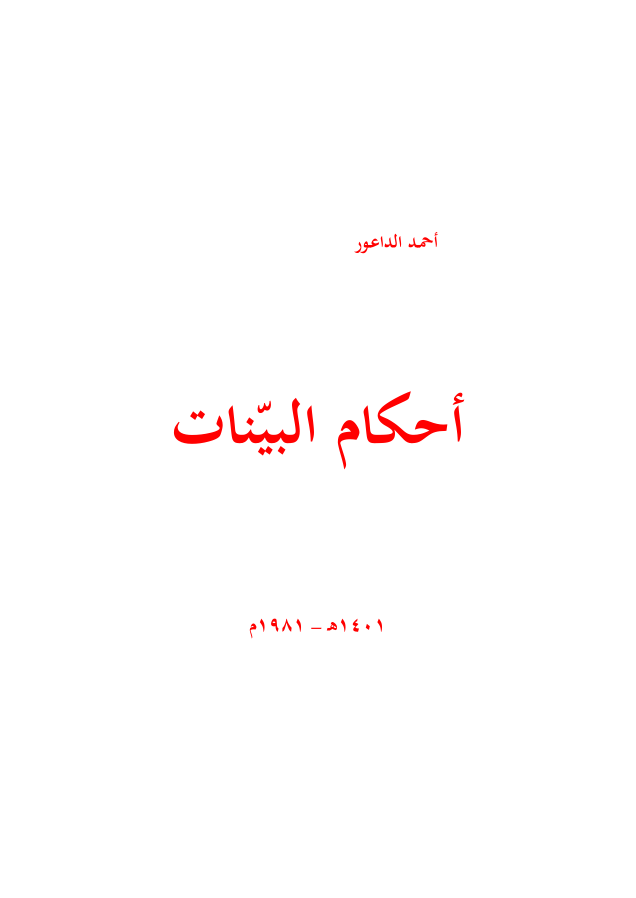
Rules of Evidence
Ahmad al-Da'our
The rulings of evidence, like other Islamic rulings, are legal rulings derived from their detailed evidence. Evidence is either related to transactions or to penalties. However, jurists did not differentiate between the rules of evidence in transactions and the rules of evidence in penalties, so they mentioned them all in the book of testimonies, and completed some of their research in the book of judgments and in the book of claims and evidence, and clarified in the research of some penalties some evidence because it is a condition of its conditions and a part of its research.
مقدمة / Introduction
The rulings of evidence, like other Islamic rulings, are legal rulings derived from their detailed evidence. Evidence is either related to transactions or to penalties. However, jurists did not differentiate between the rules of evidence in transactions and the rules of evidence in penalties, so they mentioned them all in the book of testimonies, and completed some of their research in the book of judgments and in the book of claims and evidence, and clarified in the research of some penalties some evidence because it is a condition of its conditions and a part of its research. Evidence is everything that clarifies the claim, and it is the plaintiff's argument for his claim. On the authority of Amr bin Shuaib, on the authority of his father, on the authority of his grandfather, that the Prophet, peace and blessings be upon him, said: "The burden of proof is on the plaintiff, and the oath is on the defendant." Al-Bayhaqi narrated with a sound chain of transmission on the authority of the Prophet, peace and blessings be upon him, that he said: "The burden of proof is on the plaintiff, and the oath is on the one who denies." Evidence is the plaintiff's argument by which he proves his claim. It is a proof to establish the claim, so it cannot be evidence unless it is definitive and certain, so it is not correct for anyone to testify except based on knowledge, that is, based on certainty, so testimony based on conjecture is not valid. Therefore, the Prophet, peace and blessings be upon him, said to the witness: "If you see something like the sun, then testify, otherwise, leave it." So, what comes through inspection or what is similar to it, such as what comes through one of the senses and is certain to distinguish the tangible, and that is from knowledge, that is, from certainty, then it is permissible for a person to testify to it, and what does not come through this way, it is not permissible to testify to it because it is only about certainty. If it is certain, such as the testimony of hearsay by which things are validated, such as marriage, lineage, death, and the like, then it is permissible for the witness to testify because he is certain, but this is not interpreted by his testimony, because certainty is necessary for him to be valid to testify.Table of Contents
1.
Book Index
2.
Rulings of Evidence
3.
Types of Evidence
4.
Confession and Oaths
5.
Testimonies
6.
Definition of Testimony
7.
Conditions of the Witness
8.
Testimony of a Non-Muslim
9.
Quorum of Testimony
10.
Type of Witnesses
11.
Exceptions to the Quorum of Testimony
12.
Testimony of Women
13.
Who is not Allowed to Testify
14.
When Does a Non-Just Person Become Just and His Testimony is Accepted
15.
It is not Correct for the Judge to Rule Based on His Knowledge
16.
Judge's Inspection and Observation
17.
Informing and Exploration
18.
Written Documents
19.
Signed Documents
20.
Official Documents
21.
Documents Issued by Private Departments
22.
Ordinary Unsigned Documents
23.
External Documents
24.
Presenting the Document
خاتمة / Conclusion
The original document should be in the possession of the plaintiff. If it is in his possession, then it does not become evidence unless he presents it to the judge and it remains in the case file until the judge issues a ruling, and he is not entitled to retrieve it before the ruling, because it is evidence, and the insistence on evidence must continue until the ruling is issued. Do you not see that if the witness retracts his testimony before the ruling in the presence of the ruler, his testimony is considered non-existent, and so is the document. However, there is nothing to prevent taking a copy of it. If the document is not in the possession of the plaintiff, then the plaintiff must bring it. If that is not possible, then it is considered, if it is not in official circles or in the possession of the defendant, then he is considered unable to provide evidence if he does not bring it. But if it is in official circles, then the court must decide to bring the document from the department that issued it, whether the plaintiff requested it or not, as long as he was unable to bring it. But if it is in the possession of the defendant and the plaintiff requests to compel his opponent to submit it, that is, to submit the document, then it is considered, if the opponent acknowledges the existence of the document with him in a way that specifies that it is his, he is required to bring it, and if he does not bring it, his refusal to bring it is considered an acknowledgment of the document, and then the document is considered as if it were presented by the plaintiff, but with the descriptions that the opponent acknowledged. If the opponent denies that the document is with him, it is considered, if the plaintiff has a copy of it, then he is assigned to prove that the document is with his opponent, and if he is unable to prove it, the opponent swears, and if he swears, the document is rejected even if a copy of it exists, and if he refuses to take the oath, the judge considers the copy that the plaintiff has of the document to be authentic, and considers it evidence of the claim.
شارك الكتاب: